GRACE LE
BUILDS IT!
Slow Coaster
"The Unexpected"
Items Needed:

1/4" Hex Nuts
These nuts are there to prevent the bolts from going all the way through the pegboard.

Rubber Bands (Lots of them!)
They are used to make tracks for the ping pong ball. By doing so, wrap the rubber bands the bolts to do so.

2 x 2 Foot Peg Board
This board is big enough for students to build their coaster. Creativity and magic happen here!
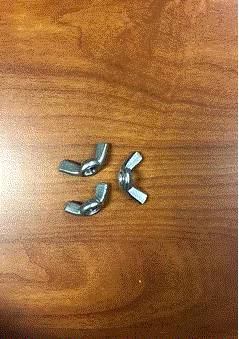
1/4 Wing Nuts
These nuts are used to secure the bolts onto the back of the pegboard.

1/4" x 3" Carriage Bolts
The bolts are placed through the board, used to make a track guide for the ping pong ball.

A Ping Pong Ball
It is a perfect size to be the rider of any slow coaster!

The Process:
As I wrap the rubber bands to the bolts, it creates a track for the ping pong ball to roll. To make the ball roll very slow, I would add rubber bands and place them to the stretched out bands. If I wanted my track to be longer, I would tie two bands together. I don't want to bands to snap cause that would hurt! Yikes!
THE FINALE
Ladies and gents, I give you
"The Unexpected"!!!
Length: 100cm
Total Time: 6.7 seconds
Speed of Coaster: 14.93 cm/sec

To find my calculations of speed, I took the distance and divided it by the time. You would first measure the distance, the length from point A to point B? Then you would time to see how long it would take from start to finish! I did all of that and found my findings.
Calculations
100cm 14.93 cm
__________ = __________
6.7 secs 1 sec
With our findings, Jeff's mother went 25cm per one second. My slow coaster went 14.93cm per one second. Therefore, Jeff's mother went faster than my slow coaster did. To find the distance and time, I did the same exact calculations, the distance over time.
So, is The Unexpected slower than Jeff's mother?
I heard that
Jeff's mom traveled 5 meters in 20 seconds!
5 meter = 500cm
500cm 25cm
=
20 secs 1 sec
Now Let's Talk Science!
Inertia
It is described as how "stubborn" an object is. The heavier an object has or whether the object has a large mass, it will be harder to move the object.
My ping-pong ball is small and has a small mass, so it doesn't have much inertia.
Change in Motion
An unbalanced force that can make an object slow down, take different turns, and/or speed up.
Once the ping-pong ball drops, it changes direction due to the unbalanced force, it changes direction
Gravity
A force that pulls everything to the ground. The ping-pong ball is being pulled down causing it to go throughout the track and drop once it hit the next level of the track.
Friction
A force that pushes and pulls an object to make it stop or slow down.
In my slow coaster, the rubber bands created friction towards ping pong ball, making it slower. Without the rubber bands in the middle of the track, the ball would have flown through.
What is Speed?
Distant Traveled
Time it Took to Travel
More Resources Here!
tandards K-6
K.P.1 Understand the positions of motions of objects and organisms observed in the environment
K.P.1.1 - Compare the relative position of various objects observed in the classroom and outside using position words such: in front of, behind, between, on top of, under, above, below and beside.
1.P.1 Understand how forces (pushes or pulls) affect the motion of an object.
1.P.1.1 - Explain the importance of a push or pull to changing the motion of the object.
3.P.1 Understand motion and factors that affect motion.
3.P.1.1 Infer changes in speed or direction resulting from forces acting on an object.
3.P.1.2 Compare the relative speeds (faster or slower) of objects that travel the same distance in different amounts of time.
3.P.1.3 Explain the effects of earth’s gravity on the motion of any object on or near the earth.
5.P.1 Understand force, motion and the relationship between them
5.P.1.1 Explain how factors such as gravity, friction, and change in mass affect the motion of objects.
ommon Core ath Standards
-
Using addition and subtraction to length
-
Estimate and measure lenghts in stardard units
-
Divide and multiply within 500
-
Solve problems involving measurement and estimation